Becoming a single mum can change almost every part of your life. Your relationships, finances, routines, plans for the future and even the way you see yourself can all shift at once.
When I became a single mum during pregnancy, I don’t think I fully understood how much my life was about to change. I knew I would be raising my child differently from the way I had imagined, but there were so many parts of single motherhood that nobody really prepared me for.
Some of those things were incredibly difficult. Others surprised me in ways I couldn’t have anticipated.
I’ve now been a single mum for many years, and when I look back, I can see how much I’ve learnt along the way. The woman I was at the beginning couldn’t possibly have known that she would eventually continue her education, build a career, create a secure home, become financially independent and raise a son she is incredibly proud of.
At the time, I wasn’t thinking that far ahead. I was much more concerned with getting through whatever was immediately in front of me.
If you’ve recently become a single mum and you’re wondering how you’re going to manage, these are ten things I wish someone had told me at the beginning.
1. You May Grieve More Than the Relationship
One of the first things I had to come to terms with was that I wasn’t only grieving the end of a relationship. I was grieving the future I thought I was going to have.
When a relationship ends, particularly when you have a child together, there can be so much wrapped up in that loss. There is the relationship itself, but there may also be the family life you pictured, the person you thought would be beside you, the identity you had within the relationship and all those quiet assumptions you had made about what the next five, ten or twenty years would look like.
The difficult thing about experiencing that loss as a mother is that ordinary life doesn’t stop while you process it. There are still feeds or school runs, dinners, appointments, work, laundry and bills. You can be deeply upset about what has happened and still have a child who needs you five minutes later.

I tried to put on a brave face for a long time. Looking back, I think I sometimes confused functioning with healing. I could carry on, get things done and take care of my son, but that didn’t necessarily mean I had processed everything that had happened.
The NHS recognises relationship difficulties, divorce, financial problems and major life changes as common causes of stress. Stress can affect sleep, concentration, mood and decision-making, which helps explain why a major relationship change can feel so consuming even when you’re still managing to function on the outside.
If you’re finding the emotional side of becoming a single mum harder than you expected, don’t measure your recovery by how efficiently you’re getting through your to-do list. Healing deserves time too.
How to Heal After a Breakup as a Single Mum
2. The Mental Load Can Be More Exhausting Than the Practical Work
Before becoming a single mum, I don’t think I understood how tiring it could be to be the person who has to remember almost everything.
It’s not simply doing the school run. It’s remembering that Friday is non-uniform day, noticing that the school trousers are getting too short, booking the dentist, checking school emails, planning dinner, remembering that the milk is running out, arranging childcare, paying the electricity bill and working out how an unexpected expense is going to fit into this month’s budget.
Then there are all the decisions that nobody else can make for you. Am I doing the right thing? Can I afford this? What happens if I’m ill? Is my child coping? Should I change jobs? What do I do next?
There isn’t always another adult sitting beside you at the end of the day to say, “What do you think we should do?”
Research into single-parent wellbeing has found that financial pressure, employment demands, childcare responsibilities and reduced social support can all contribute to stress and poorer wellbeing. For me, though, the mental load wasn’t only about money. It was the sheer number of things I had to remember, organise and make decisions about every day.
Understanding this has changed the way I think about overwhelm. Sometimes the answer isn’t becoming more productive or finding a better planner. Sometimes you simply need fewer things to carry.
That’s why I’ve become such a believer in simplifying ordinary life wherever I can. Repeat meals, automatic payments, calendars, preparing things the night before and having simple systems for jobs that come around every week aren’t particularly exciting, but they reduce the number of things I have to think about.
When you’re already carrying the majority of the responsibility, making everyday life easier isn’t laziness. It’s sensible.
Simple Routines That Make Single Motherhood Easier
3. Rest Becomes Something You Have to Protect
One of the things I discovered quite quickly was that time alone no longer appeared automatically. If I wanted some, I usually had to create it.
For me, mornings have always worked best. I like waking before my son and having some quiet time before the day properly begins. I might stretch, meditate, journal or simply enjoy a little while when nobody needs anything from me. That small amount of space helps me feel as though I’ve started the day as myself rather than immediately moving into everything I need to do for everybody else.

Your version of that might look completely different. Perhaps your quiet time comes after your children have gone to bed or when a grandparent has them for a couple of hours. Maybe you sit with a cup of tea and a book, walk the dog, garden, have a bath, do some skincare, work on a hobby or simply go to bed early.
I’ve come to think that self-care becomes unhelpful when it turns into another list of things women are supposed to do. The point isn’t to have the perfect morning routine, practise yoga every day or create an elaborate evening ritual. It’s to recognise when your energy is running low and find realistic ways of replenishing some of it.
Movement can be part of that too. NHS guidance explains that physical activity can improve mood and help reduce stress, anxiety and mental fatigue. Evidence reviewed by the World Health Organization also suggests that access to green and blue spaces can benefit mental health and wellbeing.
For me, something as ordinary as walking outside, stretching or spending time in nature can sometimes be far more restorative than trying to squeeze another task into the day.
Self-Care for Single Mums (That Actually Fits Into Busy Days)
4. You Were Never Supposed to Do Everything Alone
This was something I found difficult to learn because, in the early years, I wanted to prove that I could cope. I wanted to be independent and capable, particularly after my life had changed so unexpectedly.
I’m proud of the independence I’ve built, but I no longer think independence means never needing anyone.
There is a big difference between being capable of running your own life and believing you must carry every part of it without support. Research into single-parent families has identified social support as an important factor in wellbeing, while NHS advice for single parents recommends accepting practical help where possible, connecting with other single parents and considering arrangements such as childcare swaps.
Your support network doesn’t need to be enormous. It might consist of your parents, a sibling, one dependable friend, another parent who can occasionally collect your child, or a neighbour you trust. Sometimes support is practical. Sometimes it is simply having someone you can call when you’ve had an awful day.
I’ve learnt that accepting help doesn’t make me less independent. In fact, knowing when I don’t need to do something entirely alone is probably part of becoming more self-reliant, not less.
5. Money Can Feel Very Different When the Responsibility Is Yours
Money can become emotionally loaded when you are the only adult responsible for keeping your household financially secure.
An unexpected bill isn’t merely inconvenient if there is very little spare money that month. It can mean moving money from somewhere else, postponing something you wanted to do or lying awake wondering how everything will fit together.
Research with single parents has found that financial hardship can have a significant impact on psychological wellbeing. This is one reason I think conversations about single-mum wellbeing need to go beyond simply telling women to take baths and practise gratitude. Self-care matters, but it can’t remove the very real pressure of trying to make one income stretch across a household.
For me, financial independence gradually became an important part of rebuilding my life. I didn’t suddenly become brilliant with money, nor did I have some enormous income. Feeling secure became my priority. I wanted to know that the bills were covered, build savings and an emergency fund, understand where my money was going and eventually think beyond getting through the current month.
If you’re at the beginning, you don’t need to solve your entire financial future immediately. Start by understanding what is coming in and going out, check whether you’re receiving the support you’re entitled to, deal with anything urgent and then build from there.
Over time, I came to realise that financial independence wasn’t only about having money in the bank. For me, it was also about having more choice over my life.
6. Your Family Can Be Happy Without Looking Like the Family You Imagined
When I became a single mum, I had to let go of an idea of family that I had expected my child to grow up with.
That can be painful, particularly when you look around and it seems as though everybody else has the kind of family you thought you would have. But one of the things I’ve learnt over the years is that a family doesn’t need to look a particular way to contain love, security, laughter and belonging.
My son and I have built our own life together. We have our routines, traditions, jokes, holidays, difficult days and memories. In some ways, we’ve grown up together.
I don’t want to romanticise single motherhood. There have absolutely been times when having another adult to share the practical and emotional responsibility would have made life easier. But I also wouldn’t want a newly single mum to assume that because her family now looks different, her child is destined to have an unhappy childhood.
Family life is imperfect in every kind of household. You’ll lose your patience sometimes. Your child will be cross with you. You’ll forget something. You’ll serve an easy dinner because you can’t face cooking. None of that means you’ve failed.
Your child doesn’t need a Pinterest-perfect childhood. What matters far more is creating a home in which they feel loved, secure and able to be themselves.
7. Simple Routines Can Make a Surprisingly Big Difference
When you’re the only adult running a household, routines become valuable because they reduce the number of decisions you have to make.
Putting clothes out the night before, keeping school things in the same place, planning a handful of dinners, having a predictable bedtime routine and putting important dates straight into your calendar might sound insignificant. Individually, they probably are. Collectively, however, they can remove a surprising amount of everyday friction.
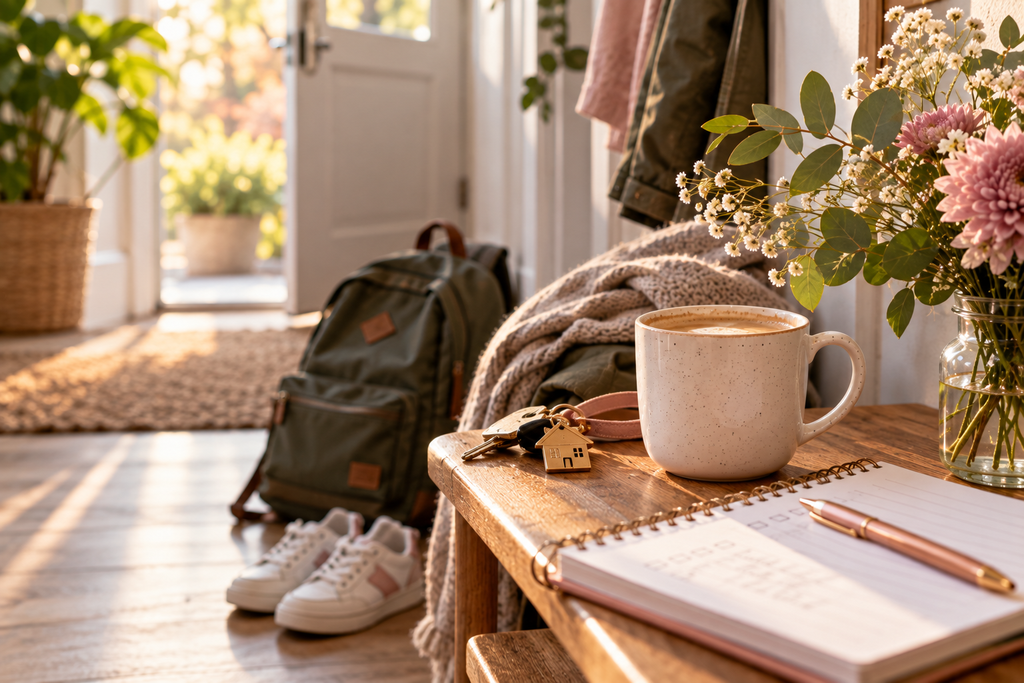
Predictability can also be reassuring for children during periods of family change. Guidance for single-parent families commonly recommends maintaining consistent routines where possible because knowing what happens next can help children feel secure.
I’ve also learnt not to overcomplicate this. The internet can make organisation look like a hobby in itself, with colour-coded planners, elaborate cleaning schedules and beautiful storage systems. None of those things are wrong if you enjoy them, but you don’t need them to run your life well.
The best routine isn’t the most impressive one. It’s the one that still works when you’re tired.
That principle has shaped a lot of the way I organise my own life. If a system requires lots of effort to maintain, it probably isn’t going to make life easier for very long.
Simple Routines That Make Single Motherhood Easier
8. Guilt Can Attach Itself to Almost Everything
Single-mum guilt is remarkably adaptable. It can appear when you’re working too much and when you’re worried you’re not earning enough. You can feel guilty about using childcare, wanting time alone, ordering a takeaway, allowing more screen time than you intended, dating again or not wanting to date at all.
You can even feel guilty for enjoying yourself when your child isn’t with you.
Eventually I started asking whether guilt was actually telling me that I had done something wrong, or whether it was simply appearing because I was trying to meet too many expectations at once.
That distinction matters. There will obviously be times when we make mistakes as parents and need to put them right, but being a good mum doesn’t require you to erase yourself. Your wellbeing, friendships, health, ambitions and future still matter.
This is one of the ideas that sits at the heart of Lily in Bloom: you can love your child deeply and still want a life that belongs to you too.
Those things don’t cancel each other out.
9. Confidence Often Comes Back Through What You Do
Becoming a single mum affected my confidence. Suddenly I was making decisions I thought I would be making with somebody else, and there were times when I genuinely questioned whether I would be able to manage everything that was now my responsibility.
My confidence didn’t return because I woke up one morning feeling fearless. It grew slowly through experience.
Every time I dealt with something difficult, made a decision, solved a problem, managed my money, advocated for my child or got through a situation I hadn’t thought I could handle, I collected a little more evidence that I was capable. Over the years, those experiences changed the way I saw myself.
That is why I think confidence is sometimes misunderstood. We can wait to feel confident before doing something, when sometimes confidence develops because we do the difficult thing while still feeling unsure.
You don’t need to become a completely different woman. You may simply need enough opportunities to discover what the woman you already are can actually handle.
How to Build Confidence as a Single Mum: From Surviving to Thriving
10. Your Future Can Look Different From the One You Imagined
When I first became a single mum, I couldn’t see very far into the future. So much of what I had imagined for my life had changed that, for a while, my focus was simply on adjusting to the reality in front of me.
I think that’s understandable. When the future you had pictured disappears, it’s difficult to immediately start imagining another one. Sometimes you need to concentrate on making life feel safe and manageable before you can begin thinking about what you want next.
That’s certainly what happened to me.
Over the years, I continued my education, built a career, became more financially independent and created a secure home for my son and me. I’ve travelled, had experiences I couldn’t have imagined at the beginning, learnt to trust my own decisions and discovered much more about who I am outside of a relationship.
None of this happened as part of some grand plan to reinvent myself. There wasn’t a morning when I woke up and decided I was going to rebuild my entire life. It happened gradually, through decisions that often seemed quite ordinary at the time: studying, working, saving, making a home, trying new things and taking opportunities when I felt ready for them.
Looking back, those small decisions changed the direction of my life, and I’m still making them now.
There are parts of my life I’m incredibly proud of, but there are also things I want to change, experiences I still want to have and dreams I haven’t achieved yet. Starting Lily in Bloom is part of that. At this stage of my life, I’m still asking myself what I want the next chapter to look like.

Perhaps that’s one of the most important things I’ve learnt. Rebuilding your life doesn’t necessarily mean trying to replace the future you lost. At some point, you get the opportunity to start creating a future based on the person you are now.
As mothers, so much of our attention naturally goes towards our children. When you’re a single mum, that can become even more intense because so much of the responsibility rests with you. For years, your questions might be: Is my child okay? How do I keep everything going? How do I make us secure?
Those questions matter. But eventually there can be room for another one:
What do I want for my life?
You don’t have to know the answer when you’ve just become a single mum. You don’t even have to ask the question yet. If you’re in survival mode, creating stability and getting through this stage may be more than enough.
But one day, when life feels steadier, you may find yourself thinking beyond what you need to cope and towards what you actually want. That’s when rebuilding can start to become something more than recovering from what happened.
It can become creating a life that feels like yours.
If You’re an Overwhelmed Single Mum, Start Here
If you’ve read this far thinking, That’s all very well, but I don’t even know where to begin, don’t try to tackle all ten things.
Instead, ask yourself one question:
What is making my life hardest right now?
If the answer is exhaustion, perhaps your first priority is rest or reducing some of what you’re carrying. On the other hand, if it’s money, start by getting a clear picture of your finances. Do your days feel chaotic? Then introduce one simple routine. If you’re lonely, think about one person you could reconnect with or one source of support you could investigate. If you’re heartbroken, give your emotional recovery some attention rather than expecting yourself simply to carry on.
And if the answer is everything, don’t create a five-year plan tonight. Think about what would make the next week or month feel slightly more manageable.
This is something I’ve come to believe strongly through my own experience of single motherhood: you don’t rebuild your whole life in one enormous act of courage. You rebuild it through small decisions, made again and again.
That’s also why I believe in focusing on one meaningful change at a time. When your life already feels overwhelming, trying to transform everything at once usually creates another source of pressure. Choosing one area to work on gives you somewhere realistic to begin.
Frequently Asked Questions About Becoming a Single Mum
Is It Normal to Feel Overwhelmed as a New Single Mum?
Yes. Becoming a single parent can mean dealing with changes to your relationship, finances, household responsibilities, childcare and emotional wellbeing at the same time. It makes sense that adjusting to several major changes simultaneously can feel overwhelming.
There is a difference, though, between life feeling difficult and feeling unable to cope. If stress is affecting your everyday life or mental health, speak to your GP or another appropriate professional rather than assuming you simply need to become better at coping. NHS guidance recommends seeking further support when stress is affecting daily life.
How Do I Cope Emotionally With Becoming a Single Mum?
There isn’t one correct way to adjust. Give yourself time to process what has happened, talk to people you trust and try not to expect yourself to rebuild every part of your life simultaneously.
For some women, journalling, walking, exercise, counselling, meditation or creative hobbies provide useful space to process emotions. For others, what they need most is practical support that reduces some of the pressure they are carrying.
If the end of a relationship is a major part of what you’re dealing with, How to Heal After a Breakup as a Single Mum would be a useful article to read next.
How Can I Make Life Easier as a Single Mum?
Look first for things you repeatedly have to think about. Those are often the easiest places to reduce your mental load.
A simple meal plan, automatic bills, preparing school things in advance, a central calendar and a handful of dependable household routines can all remove small decisions from an already busy day.
Then ask what you can simplify, automate, postpone, stop doing or ask somebody else to help with. Making life easier isn’t always about becoming more organised. Sometimes it means deciding something isn’t important enough to keep doing.
How Do I Find Support as a Single Mum?
Start with the people already around you if that feels possible: relatives, friends, other parents, neighbours, school or nursery communities. You may also find local parent groups or specialist single-parent organisations helpful.
The NHS specifically suggests accepting practical help from friends and family, arranging childcare swaps where appropriate and connecting with other single parents.
Support doesn’t have to mean handing control of your life to somebody else. Sometimes it simply means knowing there is another person you can call.
Does Being a Single Mum Get Easier?
I don’t think there is an honest universal answer to this because everyone’s circumstances are different. Children, finances, relationships, health, work and support networks all affect the experience of single motherhood.
What I can say from my own life is that I became better equipped to handle it.
Over time, I developed routines, understood my finances better, built more confidence, learnt to make difficult decisions and created greater stability. Things that once felt completely unfamiliar gradually became ordinary.
So rather than promising that single motherhood simply becomes easy, I would say that you can become more experienced, more confident and more secure within the life you’re building.
A Final Thought for the Woman at the Beginning
If you’ve only recently become a single mum, you may be looking at the years ahead and wondering how on earth you’re going to do all of this.
You don’t need to work that out today.
There were times at the beginning when I couldn’t see the life I have now. I could see what I had lost, what I was frightened of and whatever problem needed solving next. The bigger picture came much later.
So begin with what is in front of you. Take care of what genuinely needs taking care of, accept help where you can, create a little more stability and give yourself room to heal.
Then, when life begins to feel steadier, allow yourself to ask another question:
What kind of life do I want to build from here?
Not only what your child needs, what everybody else thinks you should do or what your life was supposed to look like. What do you want it to become?
You don’t need the complete answer yet. But I think every single mum deserves the opportunity to ask the question.
Because your child’s life matters enormously.
And your life matters too.
If you’re ready to begin thinking about what comes next, read How to Rebuild Your Life as a Single Mum: 6 Steps to Start Again or Surviving Single Motherhood: How to Move Beyond the Overwhelmed Phase next.