Becoming a single mum changed my life in obvious ways. My relationship ended, my future looked completely different from the one I had imagined, and I suddenly had a new role that mattered more to me than anything else: being a mum.
What I hadn’t expected was how much my sense of who I was would change too.
When I was with my ex, part of my identity was being his partner and his other half. When that relationship ended, I didn’t just grieve the person or the future I thought we would have; I also lost a role that had become part of the way I understood myself.
Later, motherhood became the biggest part of my identity. Then I became a teacher, and for years I would probably have described myself primarily using two words: mum and teacher.
Both are important parts of me. But they aren’t all of me.
It has taken me a long time to understand that finding yourself again isn’t necessarily about getting back to the woman you were before your relationship, before motherhood or before life became complicated.
Sometimes it’s about deciding who you want to become next.
Why You Can Lose Your Sense of Identity After a Breakup
If you’ve found yourself wondering Who am I now? after the end of a relationship, there is actually some psychology behind that feeling.
Researchers studying romantic relationships have found that our sense of self can become intertwined with our partner’s. Couples develop shared routines, friendships, interests and plans, and aspects of one person’s identity can gradually become incorporated into the other’s.
Research into relationship breakups has also found that they can disrupt self-concept clarity — essentially, how clearly and confidently we understand who we are. In one series of studies, reduced self-concept clarity following a breakup was associated with greater emotional distress.
That made enormous sense to me.
I wasn’t simply somebody whose relationship had ended. I was no longer somebody’s partner, and the future I had imagined belonged to a version of me that suddenly didn’t exist in quite the same way.
There can be grief in that. For some of us, another enormous identity may also be developing at the same time: Mum.
When Being Mum Becomes Your Whole Identity
Motherhood changed me profoundly, and being a mum will always be one of the most important parts of my life. But after several years of concentrating on raising my son and building a secure life for us, I began to wonder who I was outside motherhood.
Then work became another enormous part of my life. I trained as a teacher and built a career, while also having a home to run, bills to pay and a child depending on me.
Life required me to be sensible, organised, responsible and self-sufficient. Those qualities helped me build stability, and I’m proud of that.
Somewhere along the way, though, quieter parts of me disappeared into the background.
Before life became so serious, I loved being creative. I wrote, painted, took photographs, sang and danced. I loved reading, spirituality, personal development and learning new things.
I’d always dreamed of writing. When I was younger, I imagined becoming a published author, presenting television programmes or writing for a glossy magazine.
That woman hadn’t completely disappeared.
I had simply stopped giving her very much room to exist.
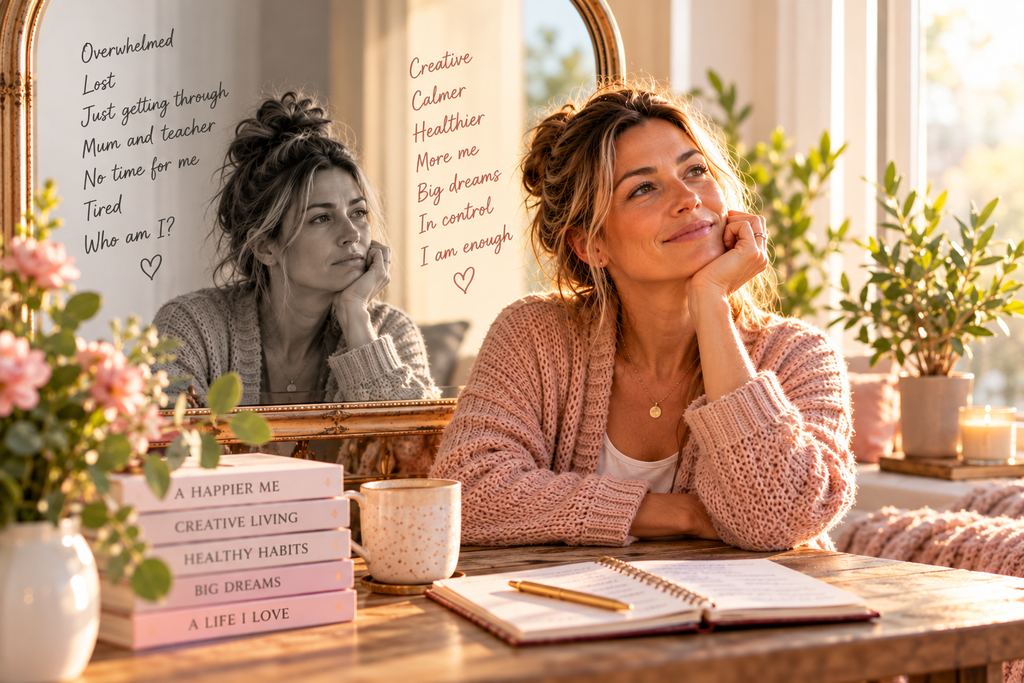
Survival Mode Can Leave Little Space for Exploring Who You Are
When you’re concentrating on getting through the day, questions such as What would I love to create? or Who would I like to become? can feel like luxuries.
My attention was on practical things: work, money, parenting, the house, responsibilities and getting through another week. Creativity requires some degree of mental space, and I didn’t feel as though I had much.
Over time, I became extremely good at being responsible. What I became less good at was remembering that I was allowed to be other things too: creative, playful, curious, feminine, rested and ambitious in ways that had nothing to do with my existing career.
That distinction matters to me now because I don’t believe finding yourself again means rejecting motherhood or the responsible life you’ve built.
It means making your identity big enough to include you too.
You Are More Than the Roles You Perform
I’ve experienced several moments in my life when I’ve questioned my identity.
The first came after my breakup: Who am I if I’m no longer his partner? Later it became: Who am I apart from being Mum?
More recently, another question surprised me: What if I don’t want being a teacher to define such a large part of me anymore?
There are plenty of other words I could use to describe myself — daughter, sister, friend, homeowner — but certain roles can become so dominant that they start taking up most of the space.
This isn’t unique to relationships or motherhood. Research into retirement, for example, has examined how leaving a major work role can involve a process of identity change as people let go of, explore and develop different identities.
Learning about this helped me see identity differently. Perhaps the question isn’t simply Who am I?
Maybe a better question is:
Which parts of my current identity still fit me — and which parts am I ready to change?
You Don’t Have to Go Back to Your Old Self
When people talk about finding themselves again after a breakup, there can be an assumption that somewhere underneath everything is your “old self”, waiting to be recovered.
I don’t think that’s what I want anymore.
There are parts of her I would love to reclaim: the woman who read books, danced, wrote, created things, learned new skills and had big dreams.
But I’ve also lived a lot of life since then. Motherhood has changed me. Heartbreak has changed me. Building a home and career has changed me. Difficult periods have changed me too.
I don’t want to erase all of that.
Perhaps finding yourself again isn’t really about returning to the woman you were before. It’s about deciding which parts of her you want to keep, recognising the woman you’ve become, and consciously choosing who you want to be next.
Identity Isn’t as Fixed as It Feels
One of the most hopeful things I’ve learned is that identity can be more flexible than we sometimes assume.
Psychological research into identity-based motivation suggests that the identities we hold can influence what feels relevant to us and how we interpret difficulty and make choices. Identity is not necessarily a single, static thing that remains unchanged throughout our lives.
Research into our possible selves — the people we imagine ourselves becoming — has also explored how future identities can contribute to motivation and self-regulation. Imagining a future version of yourself isn’t magic, of course; it becomes useful when that vision connects with what you actually do.
That distinction is important.
You can’t sit on the sofa repeating I’m a writer and expect a novel to appear. But you can begin to ask:
If writing were genuinely part of my identity, what would I do?
Then you can start doing some of those things.
I’m Learning to Think of Myself as a Writer
This is something I’m experimenting with in my own life.
For years, I said that I wanted to write. Now I’m trying to change the language slightly.
I’m a writer.
That still feels strange to say.
I haven’t allowed this part of myself much room for years, so I don’t expect everything I write to be brilliant. I think of my creative self almost like a toddler at the moment: young, wobbly and needing encouragement rather than constant criticism.
So I’m nurturing it.
I make time to write. I work on Lily in Bloom. I read and practise putting ideas into words. I’m also starting to tell people close to me that writing is something I do, rather than something I might do “one day”.
Each time I sit down and write, I am doing what a writer does.
Research into habits and identity supports the idea that the two are closely related, although researchers caution that the relationship probably works in both directions: our identity can influence our behaviour, while repeated behaviour may also reinforce how we see ourselves.
I find that reassuring.
I don’t need to wait until I completely feel like the woman I want to become before I start behaving like her.
1. Start With Self-Awareness
Before deciding who you want to become, it helps to understand the life you’re living now.
For me, journalling, walking, meditation and talking with a counsellor all helped create enough mental space to notice what was happening. I began paying attention to my thoughts and the language I used about myself.
What do I repeatedly tell myself about who I am? How do I describe myself to other people? Which roles dominate my conversations, and what do I assume I can or cannot do?
Perhaps most revealingly:
Does the way I spend my time reflect what I say matters to me?
That question changed quite a lot for me.
2. Work Out What You Actually Value
For a long time, I was working incredibly hard. I thought I was doing what a responsible adult was supposed to do, but eventually I realised there was a mismatch between the things I said mattered most and where most of my time and energy were actually going.
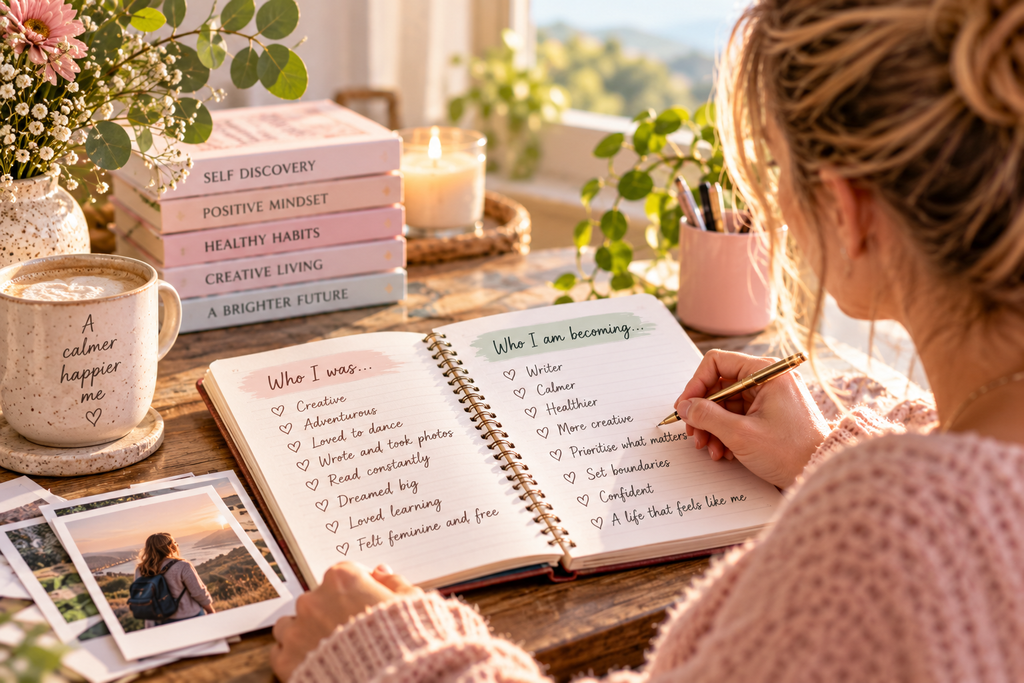
My core values include love, family, health, creativity and kindness.
Yet my life had become dominated by work.
I wanted quality time with my son, but often came home exhausted. Health mattered to me, yet I had very little energy left to look after myself. Creativity was important too, but I rarely wrote or made anything.
Even when I wasn’t physically at work, I struggled to switch off mentally. It sometimes felt as though my job had followed me home and taken up residence in my head.
Values are also an important part of Acceptance and Commitment Therapy (ACT). Within ACT, values are generally understood as ongoing qualities or directions for living rather than simply goals that can be completed and ticked off.
That difference is useful.
“Publish a book” is a goal.
“Creativity” can be a value.
You don’t have to wait until you’ve achieved the goal before you can start living the value.
A Simple Core Values Exercise
Look through these words and notice which ones matter most to you:
Love • Family • Health • Creativity • Kindness • Freedom • Security • Friendship • Adventure • Learning • Growth • Faith • Peace • Courage • Independence • Connection • Fun • Honesty • Compassion • Achievement • Community • Curiosity • Stability • Beauty • Contribution • Rest • Authenticity
Choose five rather than twenty. Then ask yourself:
If these really are my five most important values, where can I see them in my week?
That question can be uncomfortable.
It can also be incredibly useful.
3. Notice When Your Life and Your Values Don’t Match
At one point, I realised I had created a life that looked responsible from the outside but wasn’t giving enough space to several things I cared about most.
It reminded me of a metaphor I’d once read: spending years climbing a ladder, only to reach the top and discover it was leaning against the wrong wall.
I didn’t need to abandon everything I’d built. I needed to make some deliberate changes.
One of those changes was reducing my working hours. I’ve also started creating firmer boundaries around when I work, protecting my lunch break and trying not to bring work home.
Little rituals help tell my brain that the working day has ended too. Changing my clothes, taking the dog out and listening to calming music can help me make that transition.
The purpose isn’t to construct a perfectly balanced life.
It’s to stop one identity from consuming all the others.
4. Reconnect With the Parts of Yourself That Went Quiet
Think about what you enjoyed before life became so demanding.
Not because you have to become your younger self again, but because your old interests can leave clues. What did you naturally gravitate towards? What could you spend hours doing? What made you curious, and what did you stop doing because there wasn’t enough time, energy or money?
I’m gradually returning to reading, writing and swimming. I’ve started making things again too — painting, colouring and working on a dollhouse — and I’m allowing myself to have creative ambitions again.
Some old interests will return; others won’t.
That’s fine.
Rediscovering yourself isn’t an archaeological dig in which you have to recover every piece of your former personality. You’re allowed to discover entirely new things too.
5. Ask Who You Want to Become
Once you’ve looked backwards, look forwards.
Psychologists have studied the concept of possible selves — representations of the people we might become in the future. This research suggests that imagining possible future identities can be relevant to motivation, particularly when those ideas become connected to strategies and action.
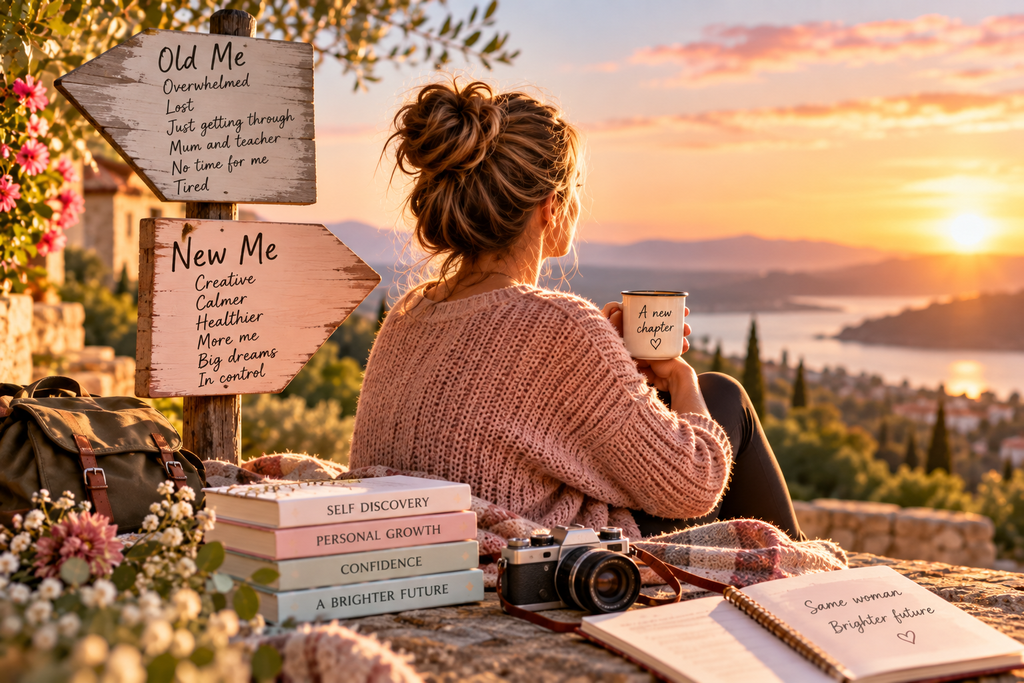
So give yourself permission to imagine.
If nobody else got to decide, who would you like to become? What would she value? What would she make time for? What would an ordinary Tuesday look like?
Think about how she would look after her health, what boundaries she might have, what she would create and who she would spend time with. Consider how she would speak to herself too.
Don’t only imagine the glamorous parts. Think about her ordinary habits. That’s where identity starts becoming practical.
6. Take Small Actions That Match the Woman You Want to Become
I want creativity and writing to become stronger parts of my identity. So I have to write.
I also want to become a calmer, healthier version of myself. That means asking what somebody who genuinely values health and calm might repeatedly do — not what an imaginary perfect woman on Instagram does.
Perhaps she walks regularly or goes swimming. Maybe she rests when she needs to, protects her evenings or chooses food that helps her feel well most of the time. She might also decide that work isn’t allowed to occupy every corner of her life.
These changes don’t all have to happen at once.
For Lily in Bloom, I keep coming back to the same principle:
One meaningful change at a time.
7. Be Careful With the Labels You Give Yourself
I’ve also become more aware of identities I don’t want to allow to define me.
Single. Unwell. Overworked.
Those words may describe a relationship status, circumstance or something I’m experiencing. They don’t have to become the whole story of who I am.
Equally, I don’t think we need to replace uncomfortable labels with forced positive affirmations we don’t believe. There is a difference between pretending and expanding.
Instead of I’m unhealthy, perhaps I can ask, What would moving towards health look like for me today?
Instead of I’m not creative anymore, I can write for half an hour. Rather than accepting work is just who I am, I can protect part of the week for something else.
The aim isn’t to deny reality. It’s to remember that reality contains more possibilities than one label.
8. Create Boundaries Around Identities That Have Become Too Big
Sometimes the problem isn’t that an identity is bad. It’s simply taking up too much room.
Being a dedicated teacher isn’t a bad thing. Being a devoted mum certainly isn’t. Independence and self-sufficiency can be enormously valuable too.
But I don’t want any one of those roles to occupy every part of my life.
Reducing my working hours and putting boundaries around work wasn’t just a diary-management decision for me. It was a way of making physical and mental space for other parts of my identity.
Writer. Friend. Woman. Creative person.
Someone who rests, has interests and adventures, and whose life isn’t entirely built around being useful to everybody else.
9. Don’t Rush to Fill the Empty Space
After a breakup, the absence of the relationship can feel enormous. There can be a temptation to fill that space immediately — with another relationship, constant busyness or a completely reinvented version of yourself.
You don’t have to.
Some of the most important work may simply be noticing what you’re feeling and learning what helps you process it. Different approaches will work for different people, and research suggests that even commonly recommended activities such as expressive writing aren’t universally beneficial in every circumstance.
For me, journalling helped. So did walking, meditation and counselling.
For you, self-awareness might develop through quiet time, therapy, conversations with somebody you trust, creative work, prayer, time in nature or simply paying closer attention to your own reactions.
The point isn’t to analyse yourself endlessly. It’s to start hearing your own voice again.
10. Let Yourself Keep Changing
This may be the lesson I needed most. I used to think finding yourself meant eventually arriving at a definitive answer: This is who I am.
Now I think differently.
My identity has changed many times, and it will probably change many more. That’s not necessarily a problem.
We are allowed to evolve.
The woman I am now doesn’t have to make every decision for the woman I’ll be in ten years. I can question things that no longer fit, put boundaries around parts of life that have become too dominant and develop interests that barely existed before.
I can become more creative again.
I can become a writer.
I can move towards being healthier and calmer.
I can still be Mum.
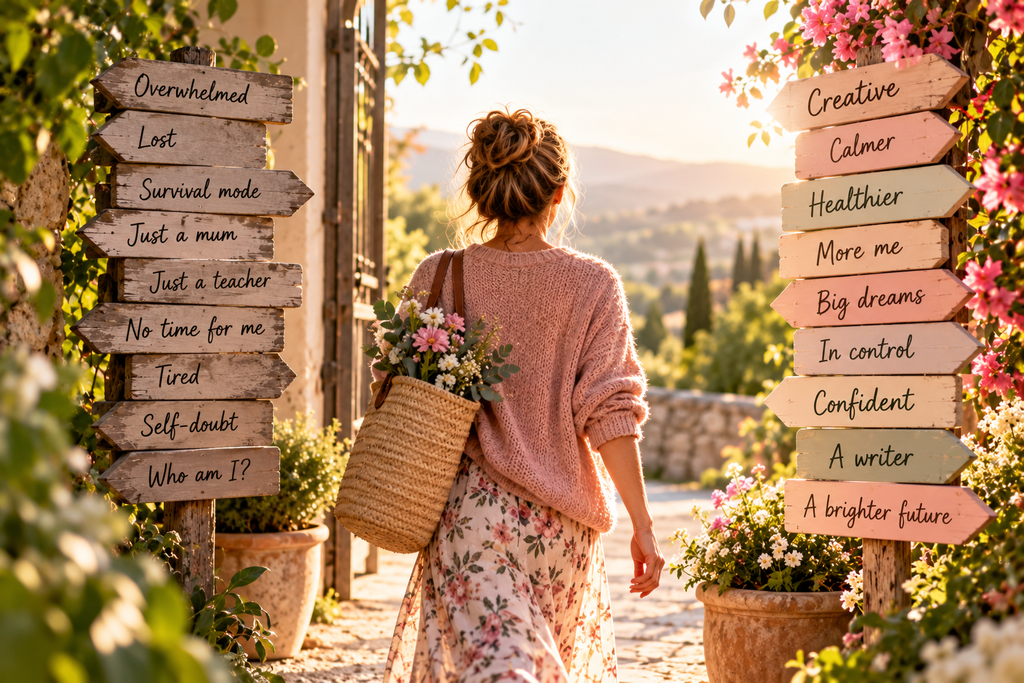
And one day, perhaps, I will choose to share my life with somebody again without needing “someone’s other half” to become my entire identity.
Finding Yourself Again Is Really About Becoming
For a long time, I thought I had lost myself. Looking back, I’m not sure that’s quite true.
Parts of me became quieter while I concentrated on survival. At the same time, other parts grew enormously: responsibility, independence, resilience and the ability to build a stable life for my son and myself.
Now I feel as though I’m entering another stage. I’m reading again, writing again and swimming. I’m creating things, thinking about what I want and allowing myself to have ambitions again.
I’m not finished. In many ways, I feel as though my creative self is only just learning to walk again. But perhaps that is what moving beyond survival looks like.
You don’t wake up one morning and suddenly discover your “true self” waiting underneath everything that happened to you. Instead, you begin to notice, question and choose — and gradually start building a life that reflects those choices.
If you’re standing at the beginning of that process after a breakup, don’t only ask:
Who am I without them?
Ask:
Who do I want to become now?
Then choose one small thing you can do this week that moves you in that direction.
You don’t have to paddle the whole river today. You just need to start steering towards the life you actually want.
A Lily in Bloom Reflection: Who Am I Becoming?
If you’d like to explore this for yourself, find ten quiet minutes and finish these sentences:
- Before life became so busy, I loved…
- The parts of myself I would like to rediscover are…
- The roles that currently take up most of my identity are…
- The parts of those identities I want to keep are…
- The things I am ready to leave behind are…
- My five most important values are…
- My life currently reflects those values when…
- My life doesn’t reflect those values when…
- The woman I am becoming is…
- An ordinary day in her life includes…
- One thing I can do this week to begin living as her is…
You don’t need to reinvent your whole life from one journal page.
Start with one meaningful change.
Where to Go Next
If you’re still in the earlier stages of rebuilding, read How to Heal Emotionally as a Single Mum After a Breakup next. Healing and identity often overlap, but you don’t have to force yourself into a reinvention project while you’re still processing what happened.
If you’re beginning to trust yourself again, How to Build Confidence as a Single Mum explores practical ways to rebuild your confidence and self-trust.
And when you’re ready to look at the bigger picture, How to Rebuild Your Life as a Single Mum: A Step-by-Step Guide can help you begin deciding what you want the next stage of your life to look like.
Your life matters too.
Build a life that’s yours, too.